Author: nlnnpc-mashinaki

  • Our fleet during World War II: Operations Dynamo and Neptune

    Our fleet during World War II: Operations Dynamo and Neptune

    [vc_row][vc_column width=”1/12″][/vc_column][vc_column width=”10/12″][us_image image=”12953″ size=”full”][us_separator size=”custom” height=”30px”][vc_column_text css=”%7B%22default%22%3A%7B%22font-size%22%3A%2222px%22%2C%22line-height%22%3A%2232px%22%2C%22font-family%22%3A%22body%22%2C%22font-weight%22%3A%22300%22%7D%7D”]Captured merchant vessels, voyages to England, heroic deeds or sunk without trace… NNPC was founded shortly before the Second World War and so there’s a treasure trove of tales about the fleet that we insured at the time. What happened to “our” ships—where did they go and did they come back?[/vc_column_text][us_separator size=”custom” height=”30px”][vc_column_text]In this series of articles, we dive into the Dutch Merchant Shipping Database for 1940-1945 to find out what happened.[/vc_column_text][us_separator size=”custom” height=”40px”][vc_column_text]

    Dunkirk and D-Day

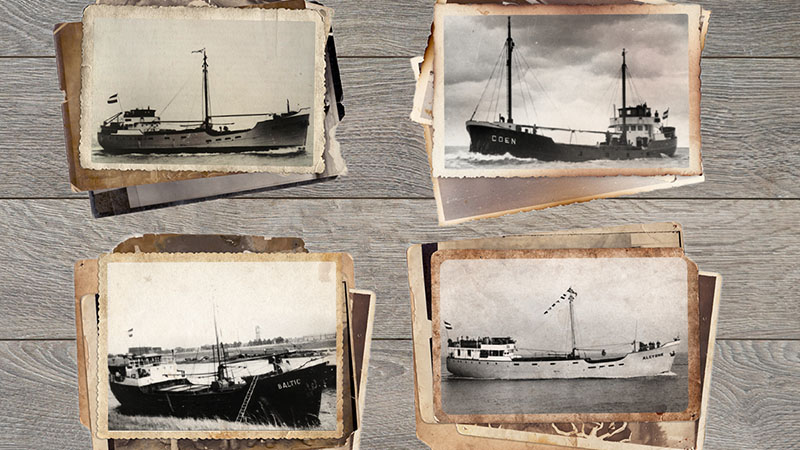
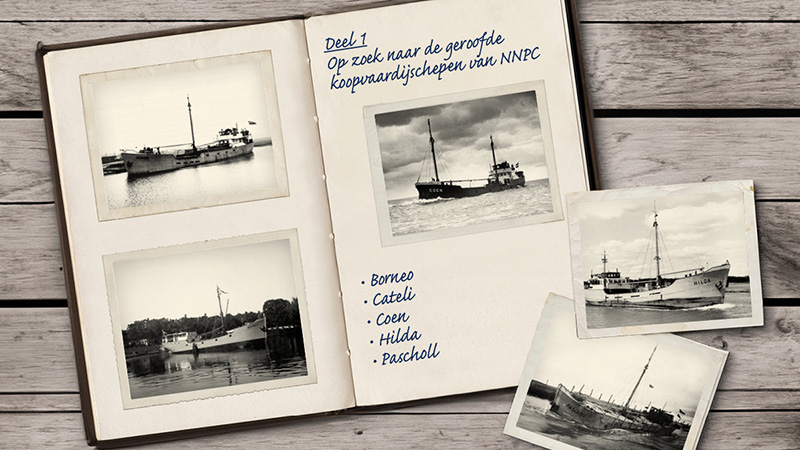
    In this first part, we’ll take a look at the ships that took part in two large-scale allied operations, Dynamo and Neptune. The first of the two was portrayed a few years ago by the director Christopher Nolan in his film “Dunkirk”. It was the successful operation to evacuate stranded British troops from a dire situation in Dunkirk, using numerous commercial and private vessels. The second was the starting signal for the world-famous amphibious Operation Overlord, better known as D-Day. We are rightly proud that ‘our’ fleet of ships played a part in it, as you can read below![/vc_column_text][us_separator size=”custom” height=”50px”][us_image image=”12879″ align=”center” size=”full” link=”url:https%3A%2F%2Fdatabank.koopvaardijpersoneel40-45.nl%2Fship%2Fview%3Fid%3D396|target:_blank” css=”%7B%22default%22%3A%7B%22animation-name%22%3A%22afl%22%7D%7D” onclick=”custom_link”][us_separator size=”custom” height=”20px”][vc_column_text el_id=”5″]

    Hilda

    The coaster Hilda managed to get away from the Netherlands in 1940 and cross over to England. In that same year, from the end of May to early June, she took part in Operation Dynamo, the evacuation of allied troops from the beaches around Dunkirk. Over several trips, she took no less than 835 soldiers back to England. There was an anxious moment for the crew of the Hilda on June 1st when the ship was attacked by German planes off the coast near La Panne. The ship itself did not suffer any damage, but the British destroyer HMS Keith, which was nearby, was badly damaged. The Hilda immediately took some of its sailors on board and brought them to safety.[/vc_column_text][us_separator size=”custom” height=”50px”][us_image image=”12884″ align=”center” size=”full” link=”url:https%3A%2F%2Fdatabank.koopvaardijpersoneel40-45.nl%2Fship%2Fview%3Fid%3D737|target:_blank” css=”%7B%22default%22%3A%7B%22animation-name%22%3A%22afr%22%7D%7D” onclick=”custom_link”][us_separator size=”custom” height=”20px”][vc_column_text el_id=”5″]

    Pascholl

    Pretty much the same happened to the Pascholl: fleeing from the Netherlands in May 1940 and then directly put to use, probably with a British crew. The ship certainly showed what it was worth, saving 695 soldiers.[/vc_column_text][us_separator size=”custom” height=”50px”][us_image image=”12889″ align=”center” size=”full” link=”url:https%3A%2F%2Fdatabank.koopvaardijpersoneel40-45.nl%2Fship%2Fview%3Fid%3D181|target:_blank” css=”%7B%22default%22%3A%7B%22animation-name%22%3A%22afl%22%7D%7D” onclick=”custom_link”][us_separator size=”custom” height=”20px”][vc_column_text el_id=”5″]

    Borneo

    There is plenty of information available about the various transport tasks carried out around the British Isles by the motorised freighter Borneo uitvoerde – and the perilous adventures of her crew. The vessel sailed in various convoys between Barry, the Seine Bay and the Bristol Channel, for instance, and was finally deployed in Operation Neptune. Skipper Jan Lamein from Veendam survived an attack by German planes on the Libelle and first engineer Ernst Johan de Vries from Rauxel came away from Operation Neptune unscathed on the Brandaris.[/vc_column_text][us_separator size=”custom” height=”50px”][us_image image=”12904″ align=”center” size=”full” link=”url:https%3A%2F%2Fdatabank.koopvaardijpersoneel40-45.nl%2Fship%2Fview%3Fid%3D213|target:_blank” css=”%7B%22default%22%3A%7B%22animation-name%22%3A%22afr%22%7D%7D” onclick=”custom_link”][us_separator size=”custom” height=”20px”][vc_column_text el_id=”5″]

    Cateli

    We know a lot less about the coaster Cateli. After crossing, once again in 1940, she was used on June 8th, 1944 for carrying parts of what were known as ‘Bailey bridges’, used during Operation Neptune in Normandy. These military bridges are made up of standard segments and can therefore be built quickly for getting equipment across rivers. They were indispensable in the fight to regain Europe.[/vc_column_text][us_separator size=”custom” height=”50px”][us_image image=”12908″ align=”center” size=”full” link=”url:https%3A%2F%2Fdatabank.koopvaardijpersoneel40-45.nl%2Fship%2Fview%3Fid%3D226|target:_blank” css=”%7B%22default%22%3A%7B%22animation-name%22%3A%22afl%22%7D%7D” onclick=”custom_link”][us_separator size=”custom” height=”20px”][vc_column_text el_id=”5″]

    Coen

    The last vessel that we want to highlight is the Coen. This ship too was used for transport duties around England, escaping by the skin of its teeth in 1941 when attacked from the air while sailing from Preston to Fremington. Fortunately, the ship was undamaged. In the summer of 1944, it was therefore able to take part in Operation Neptune, in a convoy that included the Bellatrix, the Confid, the Hondsrug, the Jacoba, the Ton-S and the Vliestroom. The Coen remained under the captaincy of just one person throughout the war, Jacob Pinkster from Oude Pekela.[/vc_column_text][us_separator size=”custom” height=”50px”][vc_column_text css=”%7B%22default%22%3A%7B%22background-color%22%3A%22%23cdf0fc%22%2C%22padding-left%22%3A%2220px%22%2C%22padding-top%22%3A%2220px%22%2C%22padding-bottom%22%3A%2220px%22%2C%22padding-right%22%3A%2220px%22%7D%7D”]

    Read the rest of the series “Our fleet during World War II” as well!

    [/vc_column_text][/vc_column][vc_column width=”1/12″][/vc_column][/vc_row]
  • Interview: NNPC Correspondents manager Niels van der Noll

    Interview: NNPC Correspondents manager Niels van der Noll

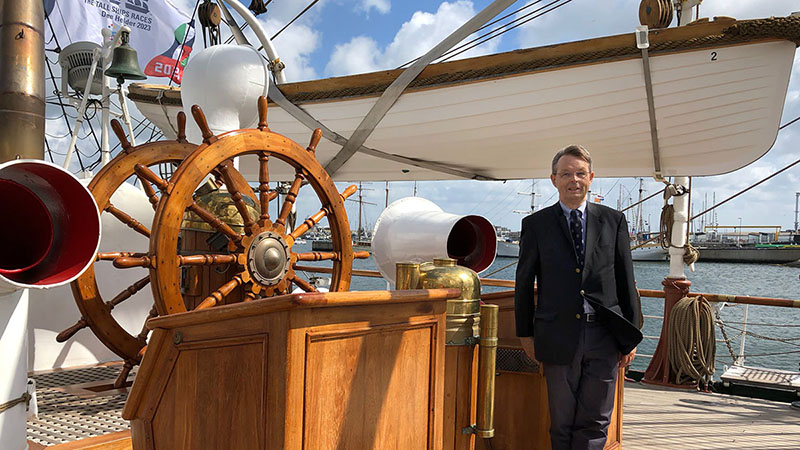
    [vc_row][vc_column width=”1/12″][/vc_column][vc_column width=”10/12″][us_image image=”12923″ size=”full”][us_separator size=”custom” height=”30px”][vc_column_text css=”%7B%22default%22%3A%7B%22font-size%22%3A%2222px%22%2C%22line-height%22%3A%2232px%22%2C%22font-family%22%3A%22body%22%2C%22font-weight%22%3A%22300%22%7D%7D”]“The number of cases for P&I correspondents has decreased during my thirty years in the business, but the times when you can provide decisive assistance have not.” NNPC interviews Niels van der Noll, manager at subsidiary NNPC Correspondents. We talk about his profession, developments in the industry and the added value of a new player in the market.[/vc_column_text][us_separator size=”custom” height=”30px”][vc_column_text]Niels van der Noll has been working in shipping since 1990. He started at an Amsterdam port company and after a few years moved to the shipping and transport company Van Ommeren. In 1994, he began working as a P&I correspondent, building a large network in Amsterdam. That made him the ideal person to help establish NNPC Correspondents in 2021.[/vc_column_text][us_separator size=”custom” height=”40px”][vc_column_text]

    Let’s start with the most important question: what is NNPC Correspondents exactly?

    “NNPC Correspondents is a P&I correspondent based in Rotterdam. From there, we are active in all Dutch seaports and on all European inland waterways. We provide solutions and assistance for our clients for a wide range of situations: cargo damage, crew matters, stowaways, but also environmental issues, bunker disputes, collisions… and that 24/7, every day of the year.”[/vc_column_text][us_separator size=”custom” height=”50px”][vc_column_text]

    How does this differ from what NNPC itself does?

    “The significant difference with NNPC is that they work worldwide for their own members, using local correspondents. We, as a separate branch, service third parties: shipowners, charterers and other P&I clubs and insurers. We focus on Dutch ports and the North Sea, extending to the rivers, canals, and inland ports of Europe.”[/vc_column_text][us_separator size=”custom” height=”50px”][vc_column_text]

    How did NNPC Correspondents get its start in recent years?

    “Even before it was founded on February 20, 2021, I was involved. NNPC had a vision of a P&I correspondent office in Rotterdam where the club’s high level of service, their network and experience in the maritime sector would be put to use. In the beginning, it was hard work to establish a position, which takes some time. Fortunately, in that first year we already received assignments, which has steadily grown in the second and third year. I can now say that we are an established P&I correspondent in the Netherlands.”[/vc_column_text][us_separator size=”custom” height=”50px”][vc_column_text]

    Being available 24/7 is quite a challenge. How do you manage that?

    “Although being available day and night is part of the job as a correspondent, the advantage of working with NNPC colleagues is that I can now hand it over to a colleague on the night and weekend shift. At NNPC Correspondents, this is well covered, but it’s a challenge for the entire industry. How do we maintain this availability and quality? That applies to all people working in the sector. Balancing 24/7 availability with having a life outside work is a balancing act.”[/vc_column_text][us_separator size=”custom” height=”50px”][vc_column_text]

    What sets NNPC Correspondents apart from other offices?

    “What I find very important is that we work well with others: experts, surveyors who conduct nautical research and take samples of cargoes, lawyers when necessary. As a correspondent, I coordinate between those parties. Good communication and keeping each other continuously informed are crucial. That’s where we differentiate ourselves. We have the experience of a P&I club. Furthermore, we have a fast response time and are both operationally and legally very strong. And we are cost-effective: our rates are competitive and we work with experts in a way that allows us to control their costs as well. We’re on top of things.”[/vc_column_text][us_separator size=”custom” height=”50px”][vc_column_text]

    You had a successful start in recent years. What does the future hold?

    “We have shown that there is sufficient room in the Netherlands for a new P&I correspondent to develop. We have gained the trust of several clients, so I expect that in the coming years we will be able to do more work for them. I have a positive outlook, but we’ll have to earn our position every day.”[/vc_column_text][us_separator size=”custom” height=”50px”][vc_column_text]

    What are the trends and developments in the profession?

    “The number of cases for P&I correspondents has decreased during my thirty years in the business, but the times when you can provide decisive assistance have not. I can remember the time of the fax and telex, but nowadays we are accustomed to a world of fast and direct communication. Back then, a significant part of communication was by mail, and you easily had to wait two weeks for a response. Now, it might come within ten minutes. That has tremendously changed the service. A captain can call a shipowner himself to inquire; he no longer needs us for that. That has altered the position of the P&I correspondent. But for complex matters, and especially those requiring local contacts and knowledge of local conditions, our expertise, know-how, and network can make a difference.”[/vc_column_text][us_separator size=”custom” height=”50px”][vc_column_text el_id=”5″]

    Do you have any final tips for the reader?

    “When in doubt, contact us. We’re always available, and often, we can quickly arrange matters to save time and costs. We know the world of shipping and P&I like no other and are therefore equipped to solve problems proactively and pragmatically. One of the most rewarding aspects of the past three years was the positive feedback from our clients and the fact that we could make a difference for them.”[/vc_column_text][us_separator size=”custom” height=”50px”][us_image image=”12863″ size=”full”][vc_column_text css=”%7B%22default%22%3A%7B%22background-color%22%3A%22%23cdf0fc%22%2C%22padding-left%22%3A%2220px%22%2C%22padding-top%22%3A%2220px%22%2C%22padding-bottom%22%3A%2220px%22%2C%22padding-right%22%3A%2220px%22%7D%7D”]

    NNPC Correspondents

    If you would like to know more about NNPC Correspondents, or need the expertise of an experienced P&I correspondent like Niels van der Noll, please contact us here.[/vc_column_text][/vc_column][vc_column width=”1/12″][/vc_column][/vc_row]

  • A change in the excluded area’s (excess) war insurance

    A change in the excluded area’s (excess) war insurance

    With this message we would like to inform you about a change in the excluded area’s concerning the (excess) War insurance. We take out this cover through our reinsurer, NorthStandard, in the commercial market.

    Looking at the recent developments it was decided that as of the 20th of February 2024 the Indian Ocean, Gulf of Aden and the Southern Part of the Red Sea will be excluded from cover. For the precise borders for this exclusion we would like to refer to the circular of NorthStandard:

    https://north-standard.com/insights/circulars/notice-of-an-excluded-area-in-respect-of-war-risks-for-certain-covers-2/

    This change has an effect on the Fixed insured as well as the P&I for the Charterers Liability. As of the 20th of February there is no cover for trips through this area. It is possible however to “buy back” this War cover. If you are interested in “buying back” this cover we can assist and kindly ask you to contact our Underwriting department.

  • Circular Ukraine – Update February 2024

    Circular Ukraine – Update February 2024

    We refer to our previous circulars regarding the situation in Ukraine, available on our website. We would like to inform you about the most recent developments, as received from our correspondents.

    • Russia has withdrawn from the grain agreement with Ukraine and no longer provides guarantees for the safe passage
    • The Russian Ministry of Defense has announced that ships visiting Ukrainian ports in the Black Sea may be considered as “potential carriers of military cargo” and thus as participants in the conflict on the side of Ukraine. Ukraine has taken similar positions on sailing to Russian ports in the Black Sea. As a result, the Ukrainian ports that were part of the grain deal are once again targets of attacks, as well as the ships in this area.
    • The risk of sea mines in the Black Sea remains current. We understand from our correspondents that measures to locate and dismantle mines will be intensified in the coming period.
    • For the northern part of the Black Sea, it still applies as an area excluded from insurance coverage. Any voyages in this area should be preceded by seeking advice and considering additional requirements from the government regarding travel planning and granting indemnities.

    If you have any questions, we invite you to contact us at claims@nnpc.nl.

  • Update: security situation in the Gulf of Aden

    Update: security situation in the Gulf of Aden

    With reference to our earlier updates, the situation in the Gulf of Aden remains volatile. On 19 January anti-ship missiles were fired from Yemen at a US ship in the Gulf of Aden and UKMTO has reported at least two other incidents being reported off the coast of Yemen during the night of Thursday 18th January.

    As such the guidance published earlier on the website of NNPC available via following link remains applicable. Members will need to carefully consider the safety situation on a day by day basis and prepare their voyage planning accordingly. Members should be aware that operation Project Guardian (overseen by the United Kingdom Maritime Trade Operations or UKMTO) is now well underway. Vessels that are scheduled to proceed through the Gulf of Aden are encouraged to register with the UKMTO in order provide reports and be updated of incidents and warnings issued by UKMTO.

    A link to the relevant guidance issued by Combined Maritime Forces (CMF) Guidance is attached again herewith: https://www.maritimeglobalsecurity.org/media/1062/2023-12-23-cmf-advice-to-mariners-01_23.pdf

    Members may also find it useful to consider the Ambrey threat update which is available here; https://ambrey.com/app/uploads/2024/01/AMBREY-THREAT-UPDATE-Red-Sea-and-the-Gulf-of-Aden.pdf

  • New Turkey pollution fines tariff for 2024

    New Turkey pollution fines tariff for 2024

    We wish to inform our members that new tariffs have been published in Turkey for pollution fines. Based on the advice of our correspondents we note the new tariffs as follows:

    • Pollution caused by tankers discharging petroleum and petroleum derivatives (such as crude oil, fuel products, bilge, sludge, slop, refined product, greasy waste materials etc.):
      • Up to 1,000 (inclusive) GT: TL 3,184.81 per unit GT
      • Between 1,000 and 5,000 (inclusive) GT: TL Additional 796.23 per unit GT
      • Over 5,000 GT: Additional TL 79.59 per unit GT
    • Dirty ballast discharged to sea by tankers:
      • Up to 1,000 (inclusive) GT: TL 580.25 per unit GT
      • Between 1,000 and 5,000 (inclusive) GT: Additional TL 115.76 per unit GT
      • Over 5,000 GT: Additional TL 18.37 per unit GT
    • Petrol/petroleum products (such as bilge, sludge, slop, fuel products, greasy waste materials etc.) and dirty ballast discharged to sea by vessels or any other sea vehicles:
      • Up to 1,000 (inclusive) GT: TL 1,592.40 per unit GT
      • Between 1,000 and 5,000 (inclusive) GT: Additional TL 318.49 per unit GT
      • Over 5,000 GT: Additional TL 79.59 per unit GT
    • Garbage and sewage discharged to sea by vessels and any other sea vehicles greater than 150 GT:
      • Up to 1,000 GT – TL 796.23 per unit GT
      • Between 1,000 and 5,000 GT – additional TL 159.25 per unit GT
      • Over 5,000 GT – additional TL 18.37 to be added per unit GT
    • Excessive sulphur content of marine fuels in excess of IMO Regulations:
      • Up to 1,000 (inclusive) GT – TL 706.51 per unit GT
      • Between 1,000 and 5,000 GT – additional TL 88.31 per unit GT
      • Over 5,000 GT – additional TL 17.67 per unit GT

    In addition, we note that the Marmara Sea (including the Istanbul Strait, Canakkale Strait and Izmit Bay) was declared as a Special Environmental Protection Area and apparently fines in this area will be doubled. In addition, if the vessel has more than one pollution incident within three years, the fines will be doubled and tripled on subsequent recurrences that are caused by the same offender within three years. If any dangerous substances or hazardous wastes are discharged into the sea, the fine will be 10 (ten) times the amount calculated using the category of petroleum and petroleum product fines as a basis.

    Finally, if the fine is paid before the vessel’s sailing or within 30 days, a 25% reduction will likely be applied and the shipowner will be able to reduce the fine by up to 2/3 where it takes measures to clear up the pollution.

  • Interview: Karel Maes, claims handler at NNPC

    Interview: Karel Maes, claims handler at NNPC

    [vc_row][vc_column width=”1/12″][/vc_column][vc_column width=”10/12″][us_image image=”12740″ size=”full”][us_separator size=”custom” height=”30px”][vc_column_text css=”%7B%22default%22%3A%7B%22font-size%22%3A%2222px%22%2C%22line-height%22%3A%2232px%22%2C%22font-family%22%3A%22body%22%2C%22font-weight%22%3A%22300%22%7D%7D”]“Apart from us, the only people who are so consistently busy day and night are journalists in the media. The news never stops, and neither does shipping.”
    Karel Maes began his work as a claims handler at NNPC during the coronavirus lockdown. It was a time of striking trends in the marine insurance world, he notes enthusiastically in this interview.[/vc_column_text][us_separator size=”custom” height=”30px”][vc_column_text]The leitmotiv running through Karel Maes’ career is that his work has taken him further and further north. Born and raised a Belgian, he started his career as a company lawyer in Antwerp with the Royal Belgian Shipowners’ Association and then Safmarine (now part of Maersk). He then crossed the Dutch border to work at Vroon in Breskens, until personal relationships later tempted him to move to Groningen, where he could start work at NNPC. As he puts it himself, “Further north isn’t possible any more, so this is as far as I can go.”[/vc_column_text][us_separator size=”custom” height=”40px”][vc_column_text]

    What is your role at NNPC?

    “I started here as a claims handler after talking to Johan de Haan, who was the director of claims at that time. As it turned out, we already knew each other from my time at Safmarine and so we clicked right away. The job also felt natural: handling claims, giving legal advice, helping think things through commercially, maintaining customer contacts. It was an awkward moment for me to start, in the Covid period, so I was working from home. I didn’t find it difficult, though, because I already knew the ropes.”[/vc_column_text][us_separator size=”custom” height=”50px”][vc_column_text]

    So what does it involve?

    “Shipowners take out insurance against risks: cargo damage, environmental pollution, fines and so forth. What’s special about NNPC is that we offer not only insurance but also a personalized claims service. We take over the claims served by our members completely, including direct contact with claimants such as claims agencies or governmental authorities. That’s only possible because we know our members and their vessels extremely well. It means we can step in and act quickly. And as for how that works, well, first of all we check with both our member and the claimant to see exactly what the claim is about. In many cases, the story is more nuanced than it might appear at first glance. Direct personal contact is crucial; we ring people more often than we send them e-mails. Our aim is to discover the story behind the story. Sometimes the claims are straightforward; sometimes you have more of a challenge. We also engage with the claimant – where do their interests lie and what exactly do they want? From there we find the solution, always in consultation with our members and with their commercial interests in mind.”[/vc_column_text][us_separator size=”custom” height=”50px”][vc_column_text]

    What makes NNPC different from other P&I clubs?

    “Our company is a close-knit team with short lines of communication. I speak almost every day with the various members of the board and with the people from finance or underwriting. You are exposed to pretty much everything, so the work is really varied and you have a lot of responsibility. In the role of claims handler, for instance, you tackle everything: small claims and larger ones, legal assistance and so on. On top of that, we get a lot of freedom and have a big say in how we approach the work. The feedback we get from our members shows that we’re genuinely providing added value and that our work means a lot to them. Compare that against the larger P&I clubs and shipping companies, where you often work with fewer responsibilities anyway and where you’re only focused on your own tasks. NNPC’s more manageable scale is precisely what works to our advantage: it lets us handle every claim at the management level.”[/vc_column_text][us_separator size=”custom” height=”50px”][vc_column_text]

    Could you tell us about a few recent developments in claims?

    “During the coronavirus period, say 2020 to 2022, there was a clear trend towards legal aid. Who pays the costs if the crew on board are in lockdown? And what about the costs of disinfecting the ship? It’s the same story for Russia because of the war in Ukraine: extra sanctions checks, can you still sail to the country, what about responsibilities and obligations between owners and charterers? This trend is now downwards again and we’re going back to ‘normal’ damages and P&I claims. What we are seeing is that absolutely everything is getting more expensive: surveyors, lawyers, reinsurance, you name it. There’s going to be more pressure on premiums. So we’re taking great care to stay cost-efficient so that we can keep things under control.”[/vc_column_text][us_separator size=”custom” height=”50px”][vc_column_text el_id=”5″]

    What would you say is the key benefit of being an NNPC member?

    “The personal approach and the good, fast service. Most of our members are programmed into the hotkeys in our phone system. We’re available 24/7. We regularly get messages in the evening and we respond to them straight away. Apart from us, the only people who are so consistently busy day and night are journalists in the media. The news never stops, and neither does shipping. That isn’t a sales pitch: we offer our members more service – and more constructive service – than if they were with a larger club. The ones with thousands of members, well, you can never build such a personal relationship with them. We’re very close to our members, so we know what’s going on.”[/vc_column_text][us_separator size=”custom” height=”50px”][vc_column_text el_id=”5″]

    You sometimes give presentations at universities. What’s the thinking behind that?

    “A while ago, I was at Erasmus University giving a presentation about our field of work to students in the Transport and Commercial Law programme. I’m shortly going to be doing the same at Delft University of Technology. We were asked to do that. It’s a way of sharing what we know about the subject of handling claims. We explain what a P&I club is and what it does. As well as creating a bit of name recognition, it also lets us take a first look at potential future employees. The same applies for the internships we offer.”[/vc_column_text][us_separator size=”custom” height=”50px”][vc_column_text el_id=”5″]

    Finally, do you have a golden tip for the members?

    “Yes: call us as much as possible. Signal any problems in advance as best you can, and call us right away – that’s quicker and better than writing. And, oh, above all: let us know how we’re doing. We greatly appreciate any feedback, both positive and negative. It all lets us improve the service we offer. That kind of contact is the most important thing.”[/vc_column_text][us_separator size=”custom” height=”50px”][us_image image=”12794″ size=”full”][vc_column_text css=”%7B%22default%22%3A%7B%22background-color%22%3A%22%23cdf0fc%22%2C%22padding-left%22%3A%2220px%22%2C%22padding-top%22%3A%2220px%22%2C%22padding-bottom%22%3A%2220px%22%2C%22padding-right%22%3A%2220px%22%7D%7D”]

    Contact

    If you have a claim you could use help or advice with, our experienced staff, like Karel Maes, will be happy to help. Contact us directly here.[/vc_column_text][/vc_column][vc_column width=”1/12″][/vc_column][/vc_row]

  • Red Sea and Gulf of Aden – Update

    Red Sea and Gulf of Aden – Update

    We have received several inquiries regarding the current situation in the Red Sea and the Gulf of Aden, particularly concerning the possibility of deviating to avoid these areas. We summarize the situation as follows:

    1. Deciding to deviate to avoid the Red Sea may have implications for P&I cover, as it could be seen as an unjustified deviation, potentially leading to a loss of cover. Before making such a decision, we strongly recommend that members contact the NNPC to assess the potential risks.
    2. Prior to determining if rerouting the vessel is an option, we advise owners to thoroughly review their contracts to confirm their contractual entitlement to do so.
    3. For new contract negotiations, we suggest that members include an appropriate liberty provision in their carriage contracts, allowing them to reroute to avoid affected areas.
    4. In case of disputes arising under existing contracts, the legal position must be assessed on a case-by-case basis due to the rapidly evolving and unpredictable nature of the situation. Particular attention should be given to the applicable “war risk” clause. When examining the BIMCO clauses:
      1. Under CONWARTIME 2013, owners can refuse charterers’ orders to transit an “area” if, in the reasonable judgment of the Master and/or the Owners, it may expose the vessel, cargo, crew, or other persons on board to War Risks.
      2. Under VOYWAR 2013, prior to the commencement of cargo loading, owners may cancel the charterparty or refuse to perform if it may, in the reasonable judgment of the Master and/or the Owners, expose the vessel, cargo, crew, or other persons on board to War Risks. Owners must first give charterers an opportunity to nominate an alternative safe port for loading or discharging.
      3. The test for determining whether owners have a basis to refuse to proceed is therefore subject to whether an area is deemed dangerous in accordance with the relevant clause. Owners must be able to provide evidence that an area may be dangerous or become dangerous for the vessel, cargo, crew, or other persons on board. Owners must conduct their own appropriate risk assessments before deciding to invoke the charterparty.
    5. It’s important to note that if owners refuse to proceed through the Red Sea or Gulf of Aden, and charterers’ instructions are found to be lawful, owners’ refusal to follow those orders may result in substantial claims for damages. Therefore, we recommend that members carefully consider any decisions in this regard. When sailing through these areas additional cover including for “War Risks” will be necessary.

    Finally, we refer to the recently published Combined Maritime Forces (CMF) Guidance, which can be accessed here. The guidance note informs that Operation PROSPERITY GUARDIAN has now commenced, and vessels transiting the Southern Red Sea should be aware of a significant increase in the number of coalition warships and aircraft operating in the area as part of this operation.

  • Amended regulations from the Maritime Safety Administration of the People’s Republic of China (China MSA): monitoring and inspections

    Amended regulations from the Maritime Safety Administration of the People’s Republic of China (China MSA): monitoring and inspections

    The China MSA, China’s government body that deals with all matters related to safety of shipping and the maritime industry, published new regulations on ship managers’ monitoring and vessel inspections. These new regulations came into effect on 1st of December, 2023, replacing regulations from 2014. The changes apply to all vessels that navigate, moor or operate in Chinese waters.

    In particular, the changes include a broadening of the criteria for a special follow-up inspection. In other words, a ship (or manager) will get on the inspection list faster/easier. Once on this list, this means that, without regard to the ship’s schedule, mandatory inspections will be carried out on the ships in question as they enter a port, if circumstances permit. In addition, the manager of the named vessel will be subject to more frequent and rigorous inspections and rectifications of previous inspections will be taken into account.

    Based on these new regulations, the following ships will be listed for special follow-up inspection:

    1. Vessels that have been detained at least twice during a Port State Control (PSC) inspection in the past 12 months.
    2. Vessels that have been penalized twice in the past 12 months by maritime administration authorities for serious illegal activities, such as insufficient manning, malicious shutdown of the AIS system or overloading.
    3. Vessels that after committing a maritime administrative violation do not accept their responsibility or try to escape it.
    4. Vessels that have tampered with certificates or carried out conversions on the vessel without approval and inspection from the ship inspection organizations.
    5. Vessels that have been involved in larger or multiple traffic accidents on the water for which they bear equal or greater responsibility.
    6. Vessels under the management of listed companies.
    7. Vessels listed for special follow-up according to the Provision on the Maritime Law Enforcement Assistance in Investigation.
    8. Vessels which are subject to follow-up inspections according to the China MSA.

    It is of course possible to be removed from this list, but this can only be done three months after the vessel has been listed and if a follow-up inspection has been performed by a local MSA in which no problems have been found. Afterwards an application for removal can be made.

    This is a time-consuming process and we would advise avoiding it as much as possible. This can be done by, as always, strictly following the international conventions and local laws and in addition, entering a port fully prepared for a PSC inspection.

    In case of further questions members are invited to contact NNPC via underwriting@nnpc.nl.

  • Looking for NNPC’s stolen merchant ships

    Looking for NNPC’s stolen merchant ships

    [vc_row][vc_column width=”1/12″][/vc_column][vc_column width=”10/12″][us_image image=”12681″ size=”full”][us_separator size=”custom” height=”30px”][vc_column_text css=”%7B%22default%22%3A%7B%22font-size%22%3A%2222px%22%2C%22line-height%22%3A%2232px%22%2C%22font-family%22%3A%22body%22%2C%22font-weight%22%3A%22300%22%7D%7D”]NNPC was founded in 1937 by a group of captain-owners from the north of the Netherlands who said: “We are going to set up our own insurance club.” They couldn’t possibly have known back then that within a matter of years their coastal ships were either going to be abandoned or confiscated by the Germans en masse during the Second World War. Thanks to the award-winning database of Stichting Koopvaardijpersoneel 40-45 you can now find out more about these confiscated ships.[/vc_column_text][us_separator size=”custom” height=”40px”][vc_column_text]

    Engelandvaarders

    Engelandvaarders – Nickname for Dutch men and women who fled to England by sea after the Germans occupied the Netherlands to continue the battle against the invaders.

    Dutch history around the Second World War runs parallel to that of NNPC. When war broke out, Dutch coastal shipping numbered 506 ships, of which at least 357 belonged to the province of Groningen (where the P&I club was founded). We wrote about this in a glossy we published in 2012 for our 75th anniversary: “Some of these coastal ships helped evacuate the Allies from Dunkirk and subsequently remained in England. Some of these ships helped the British Navy during the war years. In June 1944, for example, Dutch coasters were used in the Normandy landings, where they served well due to their shallow draught. In all, around forty Dutch coasters took part in the various Allied operations.”

    However, some of the coastal ships were stuck in our country after the occupation. These vessels were confiscated and either used to ship cargo in the Baltic Sea or used by the German navy. After the war, the NNPC managed to recover the ships that were stolen at the time.[/vc_column_text][us_separator size=”custom” height=”50px”][vc_column_text]

    Awarded at the Maritime Awards Gala

    A familiar history, in other words. Yet it turns out that new details continue to emerge. The Stichting Koopvaardijpersoneel 40-45, founded back in 1966, which aims to raise awareness of the role of Dutch merchant shipping during the Second World War, recently launched a database. And not just any old database as the Koopvaardijpersoneel 1945-1945 Database won the Maritime Achievement Award 2023 at the last Maritime Awards Gala. In the words of the jury it is an “initiative which in the past year has greatly raised public awareness of maritime history”.[/vc_column_text][us_separator size=”custom” height=”50px”][vc_video link=”https://www.youtube.com/watch?v=ax5XsplQIpI”][us_separator size=”custom” height=”50px”][vc_column_text]

    Our ships from the Second World War

    As the main sponsor of the gala NNPC is keen to focus on this topic especially as it is directly related to our own history. Indeed, as the name suggests, this is a database of ships, personnel and incidents that took place within Dutch merchant shipping during the Second World War. For each ship, name or incident, you can look up what took place and who was involved, insofar as this is known, of course. This information is constantly being updated whenever new facts and details emerge.

    We, of course, immediately looked up some ships from our history. The motor freighter Wilhelmina, for example, which left the Netherlands and was subsequently used to transport cargo around the British Isles. The sources do not contain any further information on it apart from a mysterious ‘incident’ in 1941. We are dying to find out more! Or take the Cornelia B, which managed to escape to England in the May of 1940. From there it was sent on a mission to France where it fell into the hands of the German occupiers. For the rest of the war, it would serve as a training ship in Kiel.[/vc_column_text][us_separator size=”custom” height=”50px”][vc_column_text]

    Taking a look at the merchant shipping of yesteryear

    In the coming period we will be delving deeper into these archives and will publish several articles on the stories of ‘our’ fleet of yesteryear. What heroic deeds were performed, which vessels were unfortunate enough to go down. If you can’t wait to see and experience what happened to our merchant ships during those war years take a look at the award-winning Koopvaardijpersoneel 1940-1945 Database.[/vc_column_text][us_separator size=”custom” height=”50px”][us_image image=”12793″ size=”full”][vc_column_text css=”%7B%22default%22%3A%7B%22background-color%22%3A%22%23cdf0fc%22%2C%22padding-left%22%3A%2220px%22%2C%22padding-top%22%3A%2220px%22%2C%22padding-bottom%22%3A%2220px%22%2C%22padding-right%22%3A%2220px%22%7D%7D”]

    NNPC

    NNPC is a non-profit mutual P&I company. You can contact us day and night for any help you need, with immediate personal attention. Worldwide. Always around.[/vc_column_text][/vc_column][vc_column width=”1/12″][/vc_column][/vc_row]